Behaviour change for leaders who need change to stick
Turning resistance into insight that moves teams forward
If every decision still finds its way to your desk...
If people avoid the conversations that matter...
If everyone's busy, but the important things keep stalling...
You're probably not looking at a capability problem. You're looking at protective patterns getting in the way.
You're not buying a service. You're buying a business that relies less on you.
Why does this keep happening?
Because most organisations don't have difficult people. They have good people protecting something important.
- Someone protects certainty by waiting for permission.
- Someone protects relationships by avoiding difficult conversations.
- Someone protects competence by staying quiet.
- Someone protects themselves from getting it wrong by never quite getting started.
Different behaviours. The same underlying pattern.
You don't have a people problem
When we mistake protection for resistance, we naturally push harder. We chase. We explain. We persuade.
That often backfires.
Once you understand what people are protecting, conversations change. Concerns surface earlier. People start talking to each other instead of through you. Decisions move faster because the real issue is finally on the table.
Meet The Ministry of Not Yet
The Ministry of Not Yet gives these protective patterns a shared language, making them easier to recognise, talk about and move beyond.
Every organisation has them. Not departments. Not personality types. Protective patterns that quietly take over when something feels uncertain, risky or exposed.
The Permission Seeker checks in before every decision, however small, because somewhere along the way certainty became safer than deciding.
The Pleaser avoids the direct conversation because it might create awkwardness, so small frustrations quietly build up underneath it instead, and you get pulled into the resolution.
The Procrastinator stays genuinely busy while the one thing that would move everything forward quietly waits.
Each protective pattern has an Enhanced Role. Named and understood they come through:
The Permission Seeker becomes the Decider.
The Pleaser becomes the Honest Ally.
The Procrastinator becomes the Initiator.
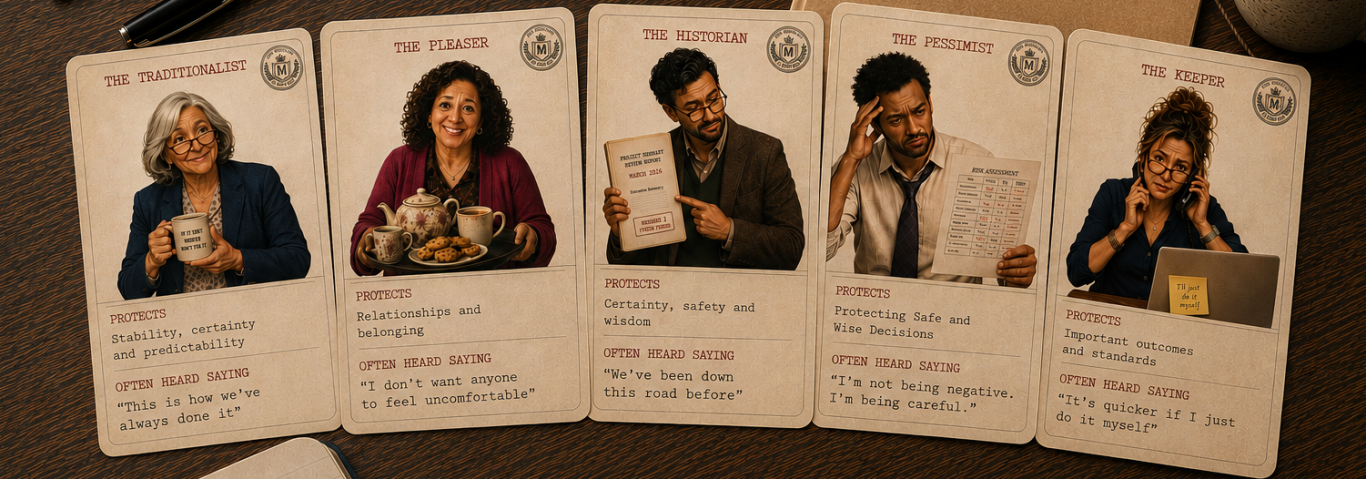
They're not difficult people.
They're protective patterns.
What starts to change
Many organisations notice conversations start happening earlier, decisions move faster, and managers resolve more issues without everything coming back to one person.
Over time, that becomes people raising concerns directly with each other, taking ownership, and giving you more time to lead rather than hold everything together.
"Emily helped me work through what was really making me avoid those conversations and shifted my mindset in just one session. I went from feeling reluctant to reach out to people to actually feeling excited about doing it.
She didn't just give generic business advice, she listened to everything I said and helped me understand the fear behind what was keeping me stuck and made the next step feel manageable.
I came away feeling clearer, more confident and able to move forward properly rather than hiding behind 'preparation mode'"
— Hollie, founder
What it's actually costing you not to fix this
It's rarely just the hours spent firefighting. It's the delayed decisions. The avoided conversations. Managers waiting for permission that was never really required. Good people quietly deciding it's easier elsewhere. Opportunities missed because nobody wanted to rock the boat.
Sometimes that ends in losing someone you couldn't afford to lose. Sometimes it's months of delay on something that mattered. Sometimes it's opportunities that quietly disappear because nobody felt able to say what needed saying.
How we work
Most development programmes fail because they're too complicated to use in the moment they're needed.
It's a practical way of recognising what's happening in a conversation and responding differently, right there in it. Because people use it every day, in 1:1s, team meetings, difficult conversations and periods of change, it becomes part of how the organisation works, not something everyone forgets by Friday.
It's built on two of the most extensively researched conversational approaches in behavioural science: Motivational Interviewing and Solution Focused practice. Rather than giving people another model to remember, it helps them have better conversations in the moments that matter most.
What happens first
We start by understanding where decisions are getting stuck and what conversations keep repeating. Together we decide what will move fastest. If I don't think I'm the right fit, I'll tell you before you spend anything.
Frequently asked questions
Is this for me, or for my team? Often both. Many leaders begin with coaching for themselves, then bring their teams in once they've got clarity on where the real barriers are.
Why do people resist change at work? Often, it's not about the change itself, it's about readiness. Someone who's "not yet" ready can look exactly like someone who's resistant, when really they're still working through what the change means for them: their confidence, certainty, relationships, or how capable they'll feel in it. Change fatigue plays a part too, if people have been through wave after wave of change without a chance to settle, hesitation is a reasonable response, not a character flaw. Reading where someone actually is changes how you approach them, and it's something I help leaders learn to spot.
Is the Ministry of Not Yet a personality test? No. The Ministry isn't about putting people into boxes. It's about recognising the protective patterns that can appear in any of us when something feels uncertain, risky or important. The same person might recognise themselves in several patterns depending on the situation they're facing. The goal isn't to label people, it's to understand what's being protected and help each pattern move towards its Enhanced Role.
What is the Ministry based on, and what's the evidence behind it? The ten patterns themselves draw on established thinking around psychological safety, and Internal Family Systems, or "parts work", the idea that every protective pattern developed for a reason, and none of them are flaws to eliminate. Once a pattern's been named, how I actually work with it comes from my clinical background of almost a decade in Motivational Interviewing and Solution-Focused practice, evidence-based approaches specifically built for understanding resistance and creating real movement forward, rather than just identifying what's going on. None of this is meant to make the Ministry feel clinical. It's built to turn genuinely evidence-based ideas into language a team can actually use.
Do you work outside the North East? Yes. I'm based in North Tyneside and work with organisations across the UK, both in person and online.
Start the conversation
If change feels harder than it should, something important being protected.
Let's find out what it is.
Book a free 30-minute conversation. No pitch, no pressure, just time to explore what’s getting in the way, and whether I can help you move it forward.
Emily Robertson, MSc · Turning resistance into insight that moves teams forward · Based in North Tyneside